


 Electric Mobility Scooters
Portable vs Threshold vs Modular Ramps: Which Do You Need?

Choosing the right wheelchair ramp can make everyday activities easier, from entering your home to moving between rooms or accessing an outdoor area. However, not every ramp is designed for the same situation. A small doorway lip requires a different solution from a raised entrance, while a home with several steps may need a more extensive access system.
When comparing portable vs threshold vs modular ramps, the main difference is the height and layout of the obstacle, how frequently the ramp will be used, and whether you need a temporary, removable or more permanent solution.
A threshold ramp is generally suitable for small lips or level changes at doorways. A portable ramp offers flexibility for steps, travel and temporary access. A modular ramp is worth considering when you need a more substantial access route that can be assembled from multiple sections.
The best choice depends on the user’s mobility equipment, the available space, the ramp’s weight capacity and the gradient needed for safe use.
Portable vs Threshold vs Modular Ramps: Key Differences
Before choosing a wheelchair ramp, compare the three main types and the situations they are designed to address.
| Feature | Portable ramps | Threshold ramps | Modular ramps |
| Main purpose | Temporary access over steps or other obstacles | Bridging small height differences | Creating a longer or more substantial access route |
| Typical applications | Home entrances, outings and suitable vehicle loading situations | Doorways, sliding doors and small raised thresholds | Raised entrances, porches and multi-step access |
| Design | Often folding, telescopic or lightweight | Usually compact, with a low-profile design | Multiple sections assembled into a ramp system |
| Portability | Generally designed to be moved | Some models can be moved easily | Usually less convenient to move once assembled |
| Installation | Often requires positioning rather than permanent installation | Depends on the model and application | May require planning, assembly and professional installation |
| Best suited to | People who need flexible access | People dealing with a small lip or step | People who need a more extensive access solution |
| Main consideration | Stability, length and safe positioning | Height, doorway clearance and trip hazards | Available space, gradient, landings and installation requirements |
These categories describe general design differences. Individual products vary, so always check the manufacturer’s specifications and instructions before purchasing.
1. What Is a Portable Wheelchair Ramp?
A portable wheelchair ramp is a movable ramp designed to help a person using a wheelchair, mobility scooter or other suitable mobility aid cross an obstacle.
Many portable models are made from aluminium and feature folding or telescopic designs. Depending on the model, they may be carried between locations, stored when not in use or positioned when access is required.
When should you choose a portable ramp?
A portable ramp may be suitable when:
- You need occasional access over a small set of steps.
- You visit friends or family members whose entrances have a suitable height difference.
- You want a ramp that can be stored when it is not required.
- You need a removable solution rather than a permanent installation.
- You regularly travel and need to address access barriers at different locations.
For example, someone who uses a manual wheelchair may need a ramp to enter a relative’s home over a suitable entrance step. A portable model could be practical if it has the correct dimensions and can be positioned securely.
However, portable does not automatically mean easy to lift or safe to use anywhere. Longer ramps can be heavy or awkward to handle, and a short ramp may create a gradient that is too steep for the user.
Advantages of portable ramps
- Flexibility: The ramp can be moved or stored when appropriate.
- Convenience: Many folding models are easier to transport than fixed systems.
- Temporary access: They may help address occasional access barriers without permanent building work.
- Multiple applications: Depending on the design, a ramp may accommodate wheelchairs, scooters or walkers.
Limitations to consider
Portable ramps need careful positioning before every use. The supporting surfaces must be suitable, and the ramp must not slide, tip or shift under load.
You should also consider whether the user can manage the ramp independently or needs a carer to position it. Wet surfaces, uneven ground, limited landing space and unsuitable gradients can create additional hazards.
For example, a telescopic ramp designed for particular steps should not automatically be used as a long outdoor access ramp. Check the product’s permitted applications and measurements first.
Affordable Living Aid offers a range of mobility products, including portable wheelchair ramp options. Its product specifications can help you compare dimensions, weight and stated load capacity before making a decision.
2. What Is a Threshold Ramp?
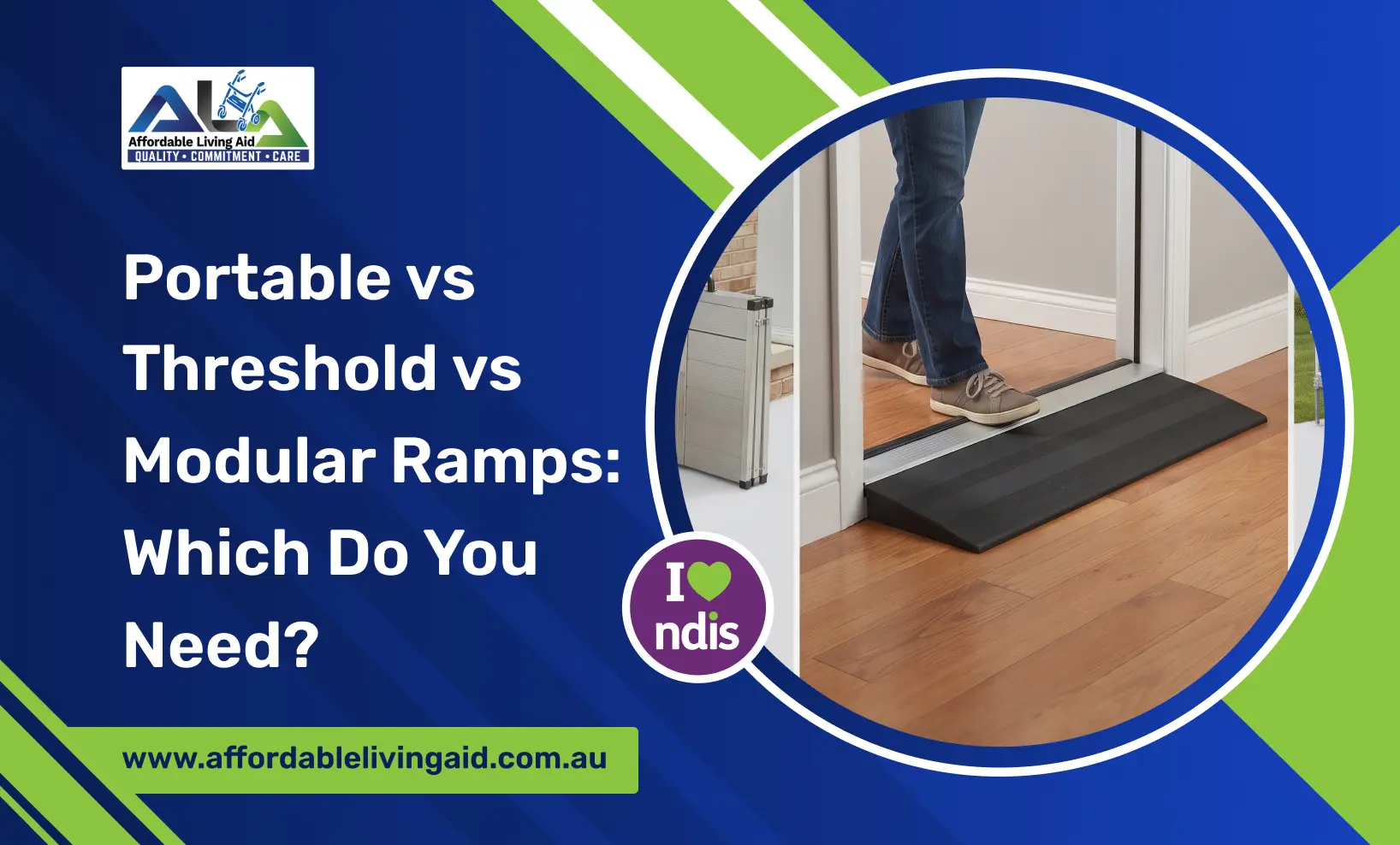
A threshold ramp is a compact ramp designed to bridge a small difference in height between two surfaces.
You might find a threshold at the bottom of a doorway, the entrance to a room, a sliding door or the transition between indoor and outdoor flooring.
Even a relatively small lip can make movement difficult for some wheelchair users or people using walkers. A suitable threshold ramp can create a smoother transition between surfaces.
When should you choose a threshold ramp?
A threshold ramp is worth considering when:
- A doorway has a small raised lip.
- A sliding door has a low track that obstructs wheelchair movement.
- There is a minor height difference between two adjoining floor surfaces.
- You need a compact solution that does not occupy much space.
- A larger ramp would be unnecessary for the obstacle.
For instance, if a wheelchair user can move around the house comfortably but struggles to cross a raised door track, a threshold ramp may address the specific problem without requiring a longer ramp.
Advantages of threshold ramps
- Compact design: They generally occupy less space than longer access ramps.
- Practical for doorways: They are designed for relatively small changes in height.
- Convenient placement: Some models can be positioned without extensive installation.
- Reduced obstruction: A correctly selected low-profile ramp can make a doorway easier to cross.
Limitations to consider
Threshold ramps are not a universal solution for steps or substantial changes in level.
Choosing one that is too short or too steep can make access difficult, particularly for a person using a manual wheelchair. The ramp must also fit the doorway without interfering with the door, reducing the usable opening or creating another trip hazard.
Check the ramp’s height range, width, surface, weight capacity and compatibility with the user’s mobility equipment.
If the doorway has an unusually shaped threshold or the surrounding floor is uneven, professional advice may be helpful before purchasing.
3. What Is a Modular Wheelchair Ramp?
A modular wheelchair ramp is assembled from multiple components to create an access route suited to a particular layout.
Depending on the system, these components may include ramp sections, platforms, landings, supports and handrails. The configuration can be planned around the available space and the height that needs to be overcome.
Modular ramps are often considered when a small portable ramp cannot provide a practical solution.
When should you choose a modular ramp?
A modular system may be appropriate when:
- Your home has several entrance steps.
- You need a longer ramp to reach a raised doorway.
- A permanent or semi-permanent access arrangement is required.
- The entrance needs a combination of ramp sections and landings.
- The access route needs to accommodate changes in direction or a particular layout.
For example, a house with a raised front porch may require a ramp that extends beyond the entrance area. A modular system could provide a planned route with suitable sections and landings, subject to the property’s dimensions and applicable requirements.
Advantages of modular ramps
- Adaptable layouts: Components can be arranged to suit different site configurations.
- Extended access routes: Multiple sections can provide a longer route than a typical compact ramp.
- Potential for reconfiguration: Some systems allow components to be rearranged when requirements change.
- Structured installation: The system can be planned around the entrance, available space and access needs.
Limitations to consider
Modular ramps need more planning than compact portable or threshold models.
You may need to consider site measurements, drainage, ground conditions, door clearances, turning space, landings and handrails. Some installations may require qualified tradespeople, permissions or building approvals.
The overall footprint can also be substantial. A ramp that reaches the required height may not fit safely within the available area if the approach is too short.
A modular system should therefore be selected according to the actual site conditions and the needs of the person using it, rather than simply choosing the longest available product.
4. How to Choose the Right Wheelchair Ramp for Your Home
The most suitable ramp is the one that addresses the obstacle safely while remaining practical for everyday use.
Use these steps to narrow down your options.
Step 1: Measure the height of the obstacle
Measure the vertical height between the lower and upper surfaces.
For a doorway, identify whether the problem is a small raised lip or a larger step. For an outdoor entrance, measure the total height that the ramp needs to overcome.
Do not estimate the height by eye alone. An inaccurate measurement can lead to a ramp that is too short or incompatible with the location.
Step 2: Check the available space
Measure the horizontal distance available for the ramp, including the approach and landing areas.
A higher step generally requires a longer ramp to achieve a manageable gradient. If space is limited, a different configuration or an assessment of alternative access options may be necessary.
Do not choose a short ramp simply because it fits the available space. A ramp that is too steep may be difficult or unsafe to use.
Step 3: Identify the mobility equipment
Consider what will travel over the ramp.
A manual wheelchair, powered wheelchair, mobility scooter and walking frame have different dimensions and handling requirements.
Check the following:
- Overall equipment width.
- Wheelbase and wheel size.
- Ground clearance, where relevant.
- Turning and manoeuvring requirements.
- Whether the equipment can safely manage the proposed gradient.
- The combined weight of the user and equipment.
The ramp’s stated weight capacity must be sufficient for the intended load. A higher load rating alone does not guarantee that the ramp is suitable for a particular wheelchair or scooter.
Step 4: Consider who will use the ramp
Think about whether the person will use the ramp independently or with assistance.
A manual wheelchair user may need a gentler gradient to reduce pushing effort. A powered wheelchair may have different operating limits, while a person using a walker may need additional stability and sufficient space.
An occupational therapist or another appropriately qualified professional can help assess individual mobility and access requirements.
Step 5: Decide whether the ramp needs to be moved
If you need access at different locations, a portable model may be more practical.
If the obstacle is a small doorway lip, a threshold ramp may be sufficient. If the same entrance needs to be accessed several times a day and involves a larger height difference, a more substantial modular solution may deserve consideration.
Step 6: Check the surface and installation requirements
Look for a suitable slip-resistant surface and a design appropriate for the intended environment.
For outdoor use, consider exposure to rain, drainage, ground stability and how the ramp will be secured. Check the manufacturer’s instructions for permitted use in wet conditions.
Also confirm whether the ramp needs edge protection, handrails, landings or other features. The requirements depend on the ramp, the site, the user and the relevant building or accessibility standards.
5. What Makes a Wheelchair Ramp Safe to Use?
Selecting the right type is only part of the decision. A ramp must also be suitable for the person and the location.
Gradient and ramp length
Gradient describes how steep a ramp is. It is commonly expressed as a ratio comparing vertical rise with horizontal distance.
For example, a gradient of 1:12 represents one unit of vertical rise for every 12 units of horizontal distance.
A shallower gradient generally reduces the effort needed to ascend and can make descent easier to control. However, the appropriate gradient depends on the intended use, the user’s abilities and the applicable requirements.
Do not assume that one gradient is suitable for every domestic ramp. Public access requirements and the needs of an individual at home may differ.
Width and edge protection
The ramp must be wide enough for the intended wheelchair or mobility aid, with sufficient clearance for safe movement.
Where required by the design, edge protection can help prevent wheels from slipping off the sides. Handrails may also be necessary, depending on the ramp configuration and applicable requirements.
Surface grip and stability
The ramp should provide suitable traction and remain stable under load.
Before each use, check for movement, damage, loose components, debris or water that could affect grip. Position a portable ramp according to the manufacturer’s instructions and confirm that its supports rest securely on suitable surfaces.
Never use a ramp that appears unstable or has damage affecting its structural integrity.
Landings and turning space
A longer access route may need level areas where a person can pause, manoeuvre or change direction.
Check that doors can open without obstructing the ramp and that the user can approach and leave the ramp safely.
For a more substantial installation, seek professional advice about the appropriate design and any applicable construction requirements.
6. Can You Use NDIS Funding to Buy a Wheelchair Ramp?
A wheelchair ramp is not automatically eligible for NDIS funding simply because it is used by a person with disability. Eligibility depends on the participant’s circumstances, the purpose of the ramp, the applicable NDIS funding rules and the type of support required.
The NDIS distinguishes between assistive technology and home modifications.
A portable ramp may be considered a home adaptation or assistive technology in appropriate circumstances. A ramp that changes the structure or fixtures of a home may instead fall under the home modifications framework.
The distinction matters because the assessment, evidence and approval requirements can differ.
Before purchasing a ramp with the expectation of NDIS funding:
- Explain the access difficulty and how it affects daily activities.
- Ask your support coordinator or NDIS contact which process applies.
- Obtain an assessment or recommendation from an appropriately qualified professional if required.
- Confirm the relevant funding arrangements and any purchasing requirements.
- Check whether the proposed ramp meets the person’s needs and applicable safety requirements.
The NDIS may require evidence that the support relates to the participant’s disability, is effective and beneficial, represents value for money and meets other applicable funding criteria.
Read the official NDIS guidance on home modifications before making financial commitments. A retailer listing a ramp for sale does not establish that the product will be funded under an individual NDIS plan.
7. Which Ramp Should You Choose?
Use the following guide as a starting point.
| Your situation | Ramp type to consider | What to check |
| A small lip at a doorway | Threshold ramp | Height, doorway clearance and transition between surfaces |
| An occasional step at a suitable entrance | Portable ramp | Length, gradient, stability and load capacity |
| Access is needed at different locations | Portable ramp | Weight, folded dimensions, handling and permitted applications |
| Several steps lead to a raised porch | Modular ramp | Available space, route layout, landings and installation |
| A permanent access route is needed | Modular ramp or another professionally assessed solution | Site requirements, approvals and applicable standards |
| A mobility scooter needs to cross an obstacle | A ramp specifically suitable for the scooter | Equipment dimensions, ground clearance, gradient and load capacity |
These recommendations are general guidance, not a substitute for an individual assessment. A portable ramp is not necessarily appropriate for every step, and a modular system is not automatically the safest option for every home.
If you are uncertain, measure the obstacle and consult a suitably qualified professional before choosing a ramp.
Find a Suitable Wheelchair Ramp for Your Needs
Choosing between portable, threshold and modular ramps starts with understanding the obstacle you need to overcome.
Threshold ramps can help address small doorway lips. Portable ramps offer flexibility for suitable steps and temporary access. Modular ramps can provide a more extensive route when a home entrance requires a larger access solution.
Whatever option you consider, prioritise the correct dimensions, a suitable gradient, adequate load capacity, stable positioning and the needs of the person using the ramp.
Affordable Living Aid offers a range of mobility products, including wheelchair ramps designed for different access situations. Explore the available options and compare their specifications before deciding which product may suit your requirements.
Need help choosing a ramp? Visit Affordable Living Aid’s mobility range or contact the team to enquire about product specifications and suitable options for your access needs.
Frequently Asked Questions
Are portable wheelchair ramps suitable for everyday use?
They can be suitable for repeated use when the ramp is designed for the application, correctly positioned and used according to its instructions. However, frequent access over a substantial height difference may justify assessing a more permanent solution.
What is the difference between a threshold ramp and a portable ramp?
A threshold ramp is designed primarily for small height differences, such as raised door tracks and doorway lips. A portable ramp is generally designed to be moved between locations and may accommodate suitable steps or other obstacles, depending on its length and design.
Are modular wheelchair ramps permanent?
Not necessarily. Modular ramps consist of assembled sections and may be removable or reconfigurable, depending on the system. Some installations are intended for longer-term use and may require professional installation or approval.
How do I calculate the ramp length I need?
Start by measuring the vertical rise and determining the appropriate gradient for the intended user and application. The required horizontal run can then be estimated using the gradient ratio.
For example, a 100 mm rise at a 1:12 gradient requires approximately 1,200 mm of horizontal run, before accounting for any additional landing or approach space.
This calculation is only a preliminary guide. It does not establish that a ramp is safe, compliant or suitable for a particular user.
Can wheelchair ramps be used in wet weather?
Some ramps are designed for outdoor use, but their suitability depends on the surface, materials, drainage, installation and manufacturer’s instructions. Check the product specifications and avoid using a ramp when conditions make it unsafe.
Does the NDIS cover portable or modular wheelchair ramps?
Funding depends on the participant’s circumstances and the applicable NDIS rules. A portable ramp may be considered assistive technology or a home adaptation, while a more substantial installation may fall under home modifications. Confirm eligibility and requirements before purchasing.